Guide
How Long Do Thermador Ovens Last? What Wears Out First
Thermador ovens typically last 15 to 20 years; here is which parts wear out first, the signs that age is the real problem, and when repair still pays.
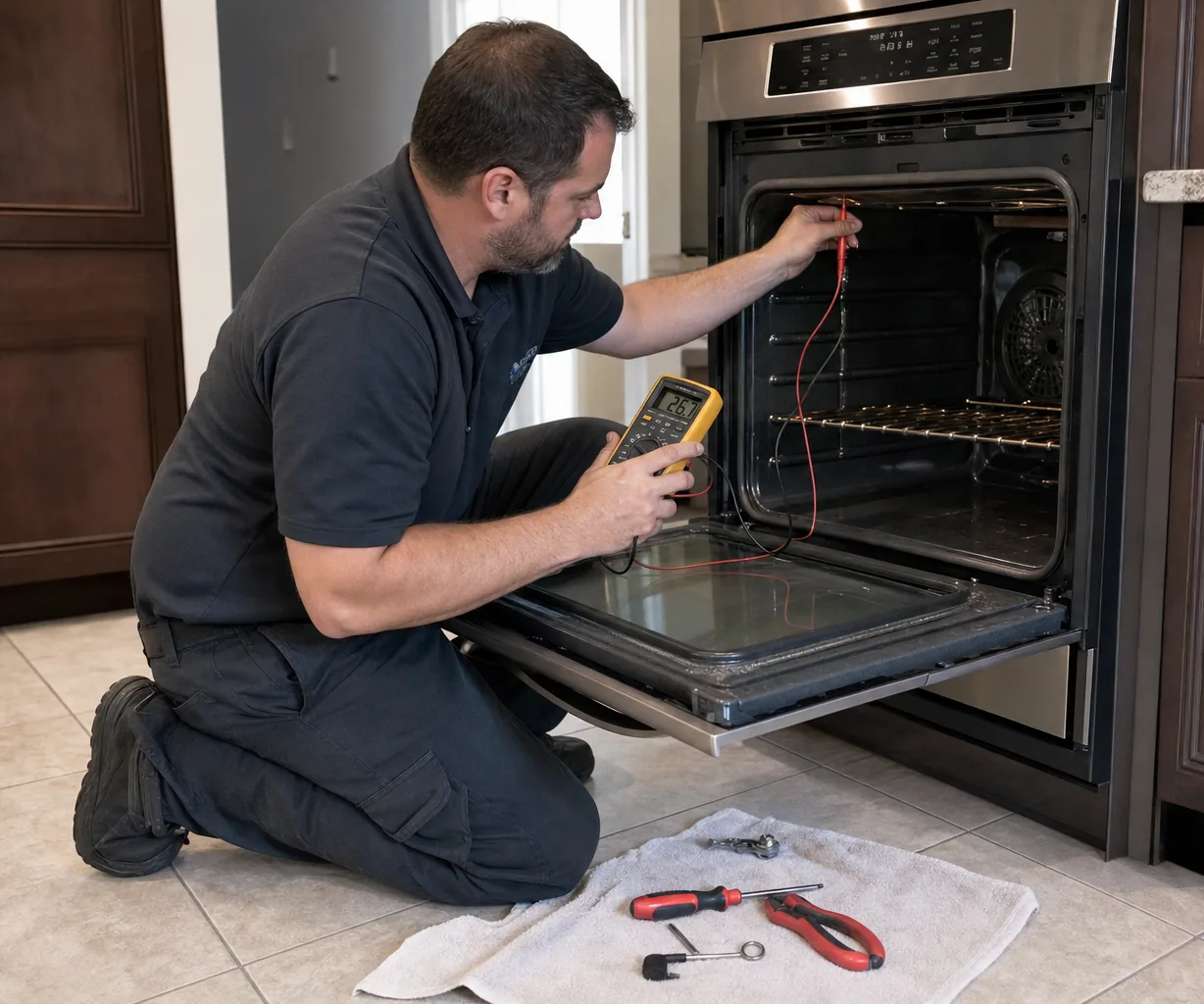
A Thermador oven typically lasts 15 to 20 years with normal home use, and the steel cavity, door and frame often outlive that span. What retires an oven early is rarely the box itself; it is usually one of five or six wear parts, and most of them can be replaced for a typical $250–$900 when the rest of the oven is sound.
This applies to Thermador wall ovens, steam ovens and the oven side of its pro-style ranges. Below: what fails first, how to tell a worn part from a worn-out oven, and when repair still makes sense. For brand background, see our Thermador repair page.
How long does a Thermador oven really last?
Think of the oven as two appliances sharing one shell. The mechanical half (cavity, door, hinges, gas valve and elements) is built heavily and can run well past 15 years. The electronic half (control board, touch panel and temperature sensor) is more sensitive to heat and power quality, and it usually decides whether an oven reaches 20 years or comes out at 12.
Three things move that number:
- How often you run self-clean. The cycle runs far hotter than any recipe, and that heat soaks into the door lock, thermal fuse and the electronics above the oven. Running it every few weeks ages those parts fast.
- Power quality. Storm outages, and the jolt when a standby generator picks up the house, are hard on touch controls. In wooded towns like Pound Ridge and Cross River, where big storms often cut power, a whole-house surge protector is cheap insurance.
- Cabinet ventilation. Wall ovens rely on a cooling fan and open air paths around the cutout. A blocked vent or dead cooling fan lets heat bake the controls from above.
Which Thermador oven parts wear out first?
Match what you see to the likely part:
| Part | What you notice | What usually fixes it |
|---|---|---|
| Gas oven igniter | Oven takes several minutes to light, will not light, or goes cold mid-bake | New igniter, then a gas valve check |
| Bake or broil element | Slow preheat, an element that stays dark, a blistered bright spot | New element and a terminal check |
| Convection fan motor | Grinding or rattling, uneven browning in convection mode | New motor or fan blade |
| Temperature sensor | Oven runs hot or cold, an error code on the display | New sensor, then a calibration test |
| Door lock and hinges | Self-clean will not start or unlock, door sags or leaks heat | New lock motor, hinges or gasket |
| Control board or touch panel | Dead or flickering display, keys that do not respond, random beeps | New board or panel, if the part is still available |
Igniters come first on gas ovens. In the common glow-bar design, the igniter must draw enough current to open the oven’s gas safety valve. As it weakens you may see it glowing while the burner never lights. A healthy one lights the burner within about 60 to 90 seconds.
Elements come first on electric ovens. The bake, broil and convection elements take every heat cycle. An element either stays dark or shorts with a bright flash or blister, and the oven still turns on but cooks unevenly.
Electronics are the expensive wild card. A temperature sensor is a modest fix. A control board or glass touch panel is what most often turns a repair into a replacement decision, because older boards get discontinued.
What are the signs that age is the real problem?
One failed part does not mean the oven is finished. Age is the real issue when several of these show up together:
- Repairs are stacking up: an element last year, a sensor this spring, now the display.
- The control board or touch panel has failed and the part is discontinued with no substitute.
- Rust has worked through the cavity enamel, or the porcelain is flaking in large chips.
- The door glass is cracked between panes, or the door frame has warped so it will not seal even with a new gasket.
- The oven is past roughly 15 years and the needed fix sits near the top of the typical range.
If only one of these fits, the answer is usually a repair, not a new oven.
Is it worth repairing an older Thermador oven?
Often, yes. Built-in ovens are sized to a cabinet cutout, and a new oven, even a newer Thermador, may not drop into the same opening without cabinet work. That alone tips many decisions toward repair.
A simple rule of thumb: repair when the fix costs less than half of a comparable new oven installed, and the oven still has useful years left. Typical ranges are $250–$500 for an oven igniter or bake element and $250–$900 for most other oven repairs. A diagnostic visit runs a typical $95–$149 and is credited toward the repair, and the firm quote is given on site after diagnosis, before any work starts. The full list of bands is on our repair pricing page.
On many double wall ovens both cavities share one control system, so a board fault can take out both, while a failed element leaves the other oven working. Knowing which it is changes the math.
How can you make a Thermador oven last longer?
- Use self-clean sparingly. Wipe spills while the oven is warm and save the cycle for a few times a year. Never run it right before a holiday meal, when a failed lock or fuse would leave you without an oven.
- Keep foil off the oven floor. It traps heat against the enamel and any concealed bake element underneath.
- Leave the vents open. Do not block the gaps around a wall oven’s trim or store anything on the vent above the door.
- Descale steam ovens on schedule. Most Pound Ridge homes draw from private wells, which often carry more minerals than a town supply. Follow the descaling prompts and the manual’s water advice.
- Replace a flattened door gasket. A leaky seal makes the elements and igniter work harder on every bake.
If your oven shows any of the signs above, a wall oven repair visit will tell you whether you are looking at one worn part or a worn-out oven.
Frequently asked questions
How long does a Thermador wall oven last compared with a range?
A Thermador wall oven and the oven in a Thermador range have similar life spans, typically 15 to 20 years. The range also has cooktop burners and their igniters, which wear on their own schedule.
What usually fails first on a Thermador oven?
On gas ovens it is usually the igniter, and on electric wall ovens it is usually a bake, broil or convection element. Both are routine repairs in a typical $250–$500 range.
Is a 15-year-old Thermador oven worth fixing?
Usually, if the cavity, door and controls are sound and parts are still available. Replacement makes more sense when a control board has failed with no part to be had, or repairs are coming every year.
Who repairs Thermador ovens in Pound Ridge?
Pound Ridge Estate Appliance Repair, an independent service, not manufacturer-authorized, repairs Thermador ovens across Pound Ridge, Bedford, Cross River, South Salem and nearby towns. Call (914) 350-6776 to book a diagnostic visit.